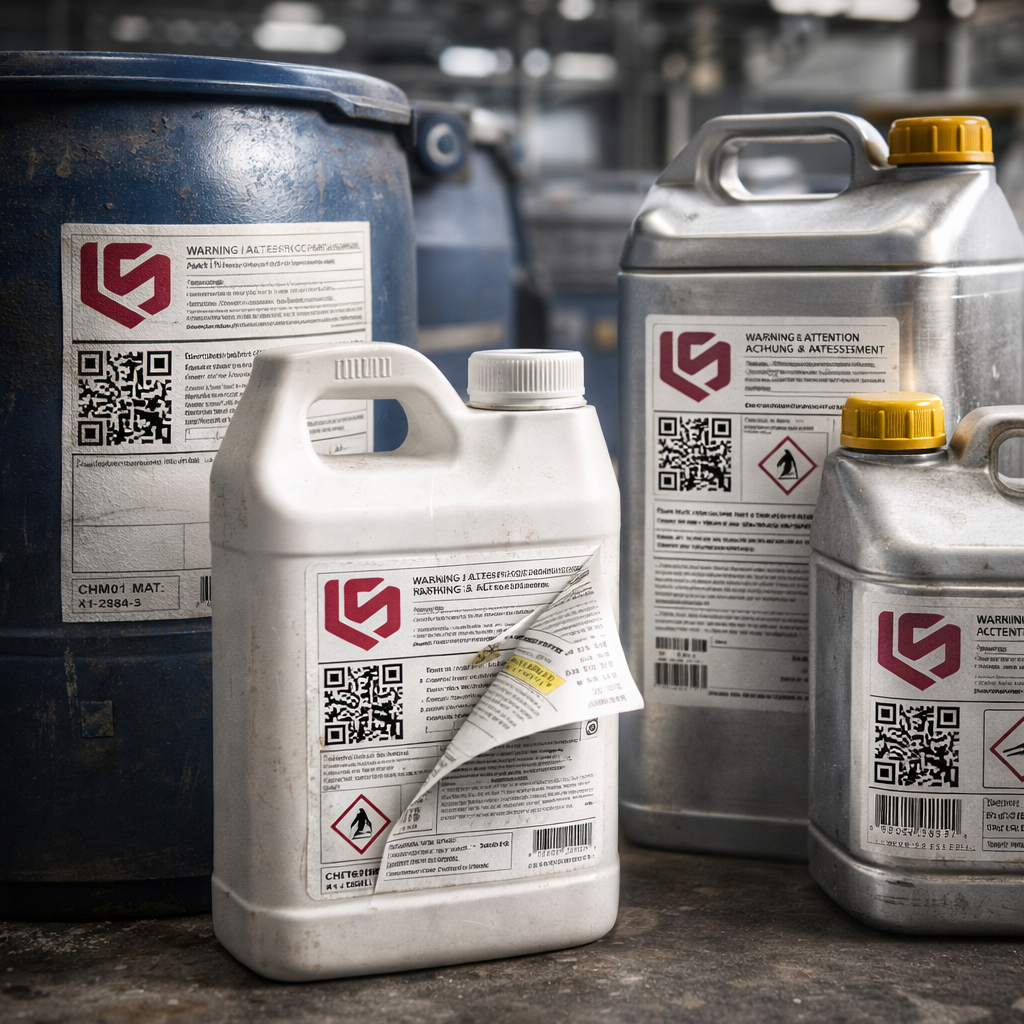
Digital Product Passports (DPPs) are moving from policy discussion to operational reality. Across industrial sectors, traceability expectations are expanding beyond basic batch coding. Manufacturers are increasingly expected to provide accessible lifecycle data covering composition, safety, repairability, and sustainability performance. QR codes have become the most practical bridge between physical packaging and digital compliance data.
However, integrating QR codes onto industrial labels requires more than simply printing a square graphic. Durability, scannability and regulatory clarity must all be considered.
Why QR Codes Are Central to DPP Compliance
Digital Product Passport frameworks are designed to make product information accessible throughout the supply chain. A QR code can link directly to hosted technical documentation, including safety data sheets, conformity declarations, maintenance records, carbon footprint data or recycling instructions.
This reduces the pressure to print extensive technical content directly on the label while still meeting transparency expectations. It also allows manufacturers to update digital documentation without reprinting physical packaging.
For industrial products with complex specifications, this flexibility is commercially significant.
The Print Quality Challenge
A QR code is only effective if it scans consistently. Industrial environments introduce risks that can compromise readability. Surface abrasion, chemical exposure, temperature variation and condensation can distort printed codes or degrade contrast.
To maintain reliable scanning performance, QR codes must be printed at sufficient resolution with high contrast against the background. The label material must resist stretching or distortion. Even minor warping can affect machine readability.
Synthetic film materials such as polypropylene or polyester are typically more suitable than paper in industrial settings. Protective laminates may also be required to shield the printed surface from wear.
Placement and Accessibility
QR code placement affects both usability and compliance clarity. The code should be positioned where it is visible without interfering with mandatory hazard symbols, warning statements or identification markings.
If a label carries both regulatory content and digital access points, structured layout is essential. The outer layer must retain legally required information, while the QR code should remain prominent and unobstructed.
In cases where information density becomes excessive, peel and reveal label constructions offer a practical solution. The outer surface can display essential compliance markings, while extended documentation or multilingual text can be positioned beneath the top layer. This preserves clarity without crowding the design.
Protecting Data Integrity Over Time
Industrial supply chains are rarely static. Products may be transported across borders, stored for extended periods or handled in challenging environments. QR codes must remain scannable throughout the product lifecycle.
Adhesive performance plays a critical role. Label lift, edge curl or partial detachment can distort the printed code and render it unreadable. High-performance adhesives designed for temperature fluctuation and surface compatibility are therefore essential.
It is also important to ensure that linked digital content remains stable. Broken links undermine traceability and weaken compliance credibility.
When Layered Labels Become Necessary
As DPP requirements expand, some industrial products may require both extensive printed information and digital traceability access. In these cases, single-layer labels can quickly become congested.
Peel and reveal labels allow manufacturers to expand physical print space while incorporating QR codes in a controlled and protected format. The structure supports both regulatory clarity and digital transparency without enlarging the container or adding secondary packaging.