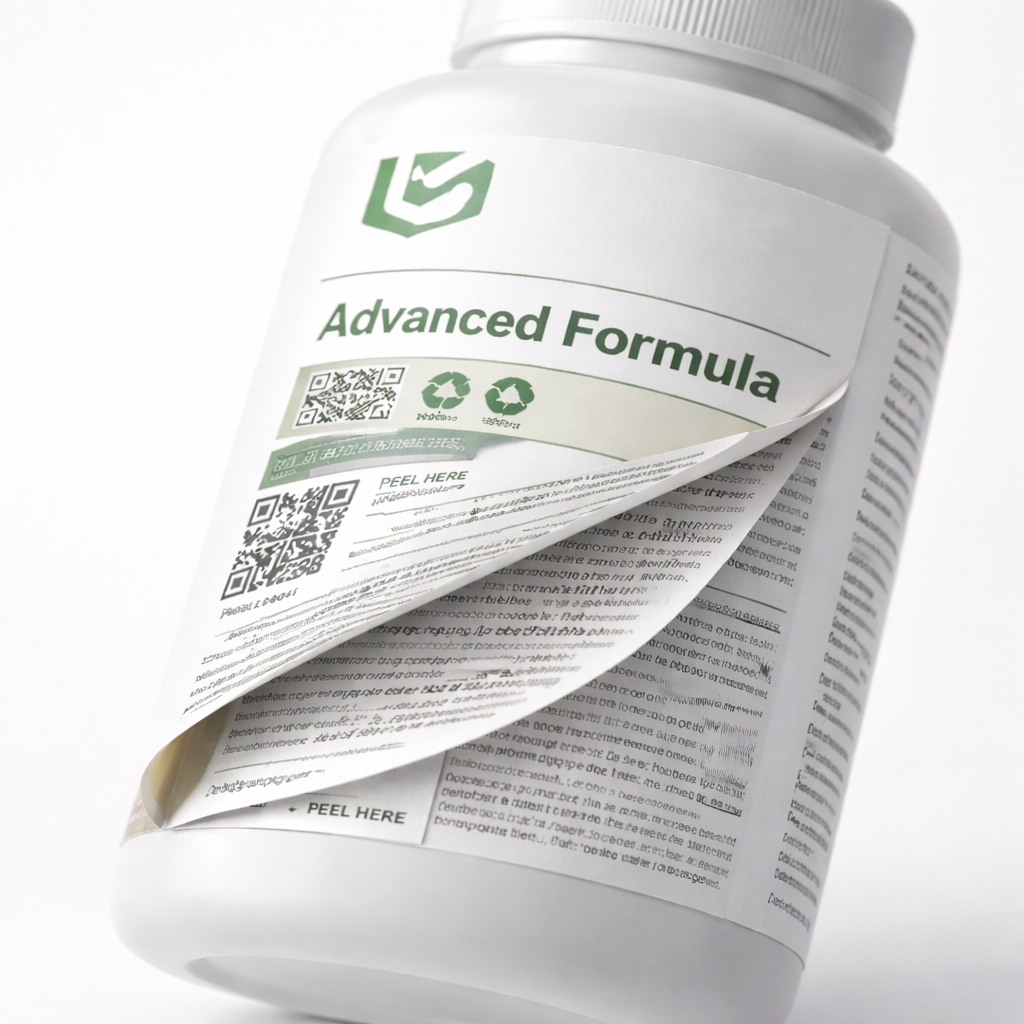
Rising resin prices driven by global supply disruptions and the introduction of higher Extended Producer Responsibility modulated fees are putting real pressure on packaging budgets across every industry in 2026. For manufacturers looking for practical ways to control costs without sacrificing regulatory compliance or consumer information, peel & reveal labels offer one of the most effective solutions currently available.
What Are Peel & Reveal Labels?
Peel & reveal labels consist of a permanent base layer that adheres securely to the container and one or more peelable top layers that users can lift to access additional information. The construction functions like a compact, multi-page label within a single slim footprint. When the top layer is peeled back, it reveals extra text, instructions, warnings, or multilingual content underneath while the base label remains firmly in place.
This design delivers the information capacity of a booklet label without the added bulk, complexity, or slower application speeds often associated with traditional multi-page constructions.
How Peel & Reveal Labels Help Reduce Overall Packaging Costs
The primary cost-saving comes from superior information density. Instead of printing separate leaflets, booklets, or using larger outer cartons to accommodate regulatory text, you can fit extensive details — including full ingredient lists, safety data, dosage instructions, storage guidance, or multiple language translations — directly onto the product label. This consolidation frequently eliminates the need for additional packaging components, cutting both material usage and assembly costs.
In the current environment of elevated PE, PP, and PET resin prices, peel & reveal labels also allow manufacturers to maintain or even reduce the total amount of film or paper used compared with bulkier alternatives. Because the label remains compact, it can lower shipping weight and storage space requirements further down the supply chain, delivering secondary savings.
Practical Advantages for Production and Durability
Peel & reveal labels are designed to run efficiently on most standard labelling equipment, avoiding the slower line speeds and higher setup costs typically seen with conventional booklet labels. When produced with high-quality adhesives, strong hinge constructions, and protective varnishes, they offer excellent durability. The top layers can be opened and reclosed multiple times without tearing or delaminating, maintaining professional appearance throughout the product’s shelf life.
For brands facing frequent regulatory updates, the format also provides flexibility. New information can often be incorporated with minimal redesign, helping avoid costly full-label reprints.
When Peel & Reveal Labels Deliver the Strongest Savings
Peel & reveal labels perform particularly well in categories with strict labelling requirements and limited pack space. They are widely used in cosmetics, chemicals, food and drink, pharmaceuticals, and medical devices. In sectors hit hardest by the current resin price surge, switching to or increasing the use of peel & reveal constructions can help offset rising material costs by simplifying the overall pack format and reducing the need for supplementary inserts or cartons.
Many manufacturers are also combining peel & reveal technology with QR codes. The printed layers handle essential safety and usage information while the QR code provides access to digital content such as detailed technical data, videos, or postcode-specific recycling advice. This hybrid approach maximises information delivery while keeping material usage low.